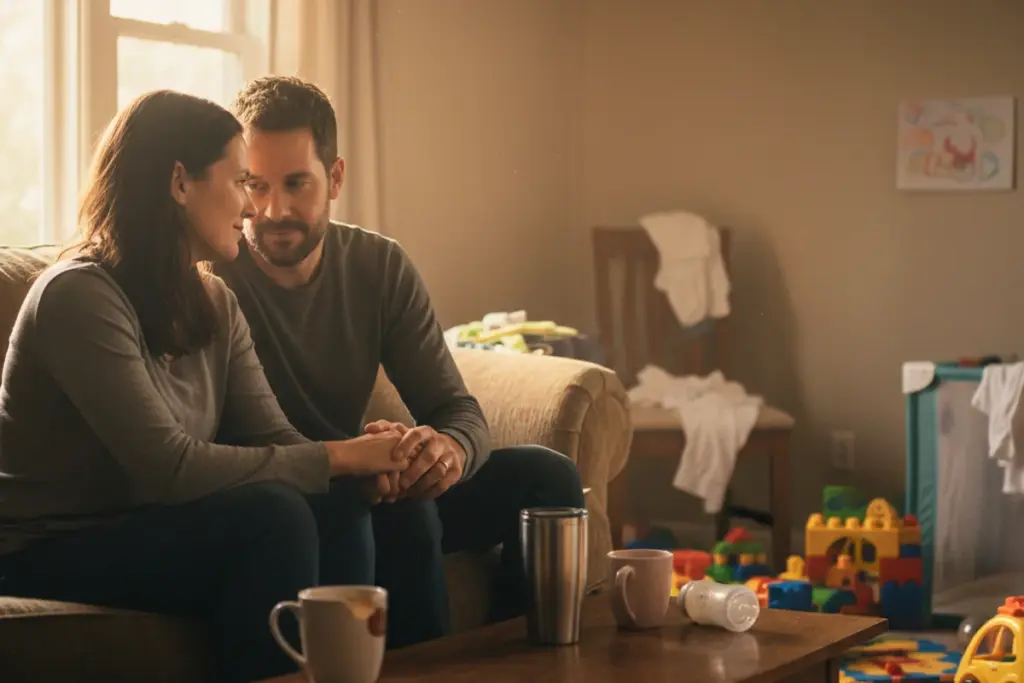



You just brought a human being into the world. The nursery is set up, the onesies are washed, and somewhere between the feedings and the diaper changes, you and your partner had your first real fight. Not a bicker about whose turn it is to load the dishwasher — a real, raised-voices, tears-in-the-kitchen fight.
If that sounds familiar, you’re not alone. And you’re not failing.
Why does the first fight after baby feel so devastating?
The first fight after a baby arrives hits different because everything hits different now. Your body is recovering, your hormones are recalibrating, your sleep is fragmented into pieces that don’t add up to rest. You’re both running on empty, and then the smallest thing — an unwarmed bottle, a forgotten text, a comment about how you’re holding the baby — lights a fuse you didn’t know was there.
Before the baby, arguments had space. Post-baby arguments happen in compressed time windows between feedings, in hushed tones because the baby finally fell asleep, or through exhausted eye rolls at 2 AM. There’s no room to breathe, and that makes every disagreement feel ten times worse.
What the first fight is really about
Here’s something most couples don’t expect: that first fight is rarely about what you’re actually fighting about. The surface argument might be about dishes or who woke up for the third time, but underneath it lives something far more vulnerable.
One of you might feel invisible. The other might feel criticized. One might be carrying a mental load they didn’t sign up for, and the other might feel shut out. When you’re both depleted, these undercurrents surface through the most convenient trigger available — even if that trigger is just a towel left on the floor.
The transition to parenthood reshapes identity. You’re co-managers of a tiny, demanding human now, and that shift also grieves the version of “just us” that existed before. That grief shows up as irritability, and irritability shows up as a fight.
Why this fight is actually a good sign
It sounds counterintuitive, but the fact that you’re fighting means you still care. Apathy — not conflict — is the real relationship killer. The first fight after baby is evidence that both of you are still invested, even if you’re expressing it poorly right now.
Research on new parents consistently shows that conflict increases in the first year. Nearly 90% of couples report more disagreements in the first six months postpartum. You’re not broken. You’re in the hardest transition most couples will ever face, and you’re doing it on zero sleep.
The couples who struggle the most aren’t the ones who fight — they’re the ones who fight without ever repairing, or who stop fighting altogether.
How to handle the fight when you’re in it
When the anger is hot and the baby is finally asleep, it’s tempting to go all in on the argument. Resist that urge. Here’s what works instead.
Name the real feeling. Before you say another word about the dishes or the diaper change, try saying what’s underneath. “I feel like I’m doing this alone” hits differently than “You never help.” The first invites connection. The second invites defense.
Take a micro-pause. Even sixty seconds of breathing in another room can shift the conversation from reactive to reflective. If the baby is safe, step away and come back when your nervous system has had a beat to reset.
Avoid the scorecard. Nothing derails a postpartum argument faster than tallying who did what. Sleep-deprived memory is unreliable. Instead of “I did three night feeds last night,” try “I’m exhausted and I need help tonight.” Same information, entirely different reception.
Lower the bar for communication. Right now, a muttered “I’m struggling” across the dark nursery counts as emotional disclosure. Accept imperfect communication. Perfection is a luxury you don’t have.
Repairing after the fight
The fight itself is less important than what comes after. Gottman’s research on couples shows that repair attempts — the small gestures that signal “I still love you even though we just yelled” — are what separate couples who make it from couples who don’t.
A repair can be a hand on a shoulder, a text saying “I’m sorry about earlier,” or a quiet “Can we try that conversation again?” The goal isn’t to resolve everything in one sitting — it’s to signal that the relationship is bigger than the argument.
After your first postpartum fight, try this: when you’re both calm, sit down and say, “I don’t want us to do that again. Can we figure out a better way?” That question shifts you from adversaries back to teammates. And that shift, more than any single resolution, is what protects your bond through the newborn months and beyond.
If you’re still carrying unspoken resentment about the division of labor, read our guide on delegating without micromanaging — it addresses exactly this kind of tension. And if the argument circled back to who’s tracking what and when, our piece on mental load and invisible labor might help you name what’s really going on.
Building patterns that last
The first fight sets a pattern, and that pattern can either serve you or erode you over time. The couples who navigate early parenthood well aren’t the ones who avoid conflict — they’re the ones who learn to fight in a way that leaves the relationship intact.
Start small. Agree on a “fight rule” that works for both of you — no name-calling, a mutual timeout policy, or a commitment to check in the next day even if the issue isn’t fully resolved.
Create a habit of quick repair. A five-second hug, a “that was hard” acknowledgment, or making your partner’s coffee the next morning — these micro-repairs compound into resilience over time.
When to seek help
One fight is normal. A pattern of fights that leave one or both of you feeling unsafe, unheard, or hopeless is different. If your arguments regularly include contempt, stonewalling, or threats — or if you feel like you can’t be honest without triggering a blowup — that’s worth addressing with a professional.
Postpartum anxiety and depression can masquerade as relationship conflict. If either of you is experiencing persistent sadness, disproportionate rage, or detachment from the baby or each other, reach out to a therapist. There’s no weakness in getting support during the most demanding transition of your life.
The bottom line
Your first fight after baby isn’t a sign that something is wrong. It’s a sign that two sleep-deprived people are trying to navigate the biggest life change they’ve ever faced, and they’re doing it imperfectly — which is exactly what humans do.
What matters is what you do next. Repair generously. Communicate honestly, even if it’s messy. Remember that you’re on the same team, even when it doesn’t feel that way. The first fight is not the beginning of the end. It’s the first test of the partnership you’re building — and every test you face together makes it stronger.