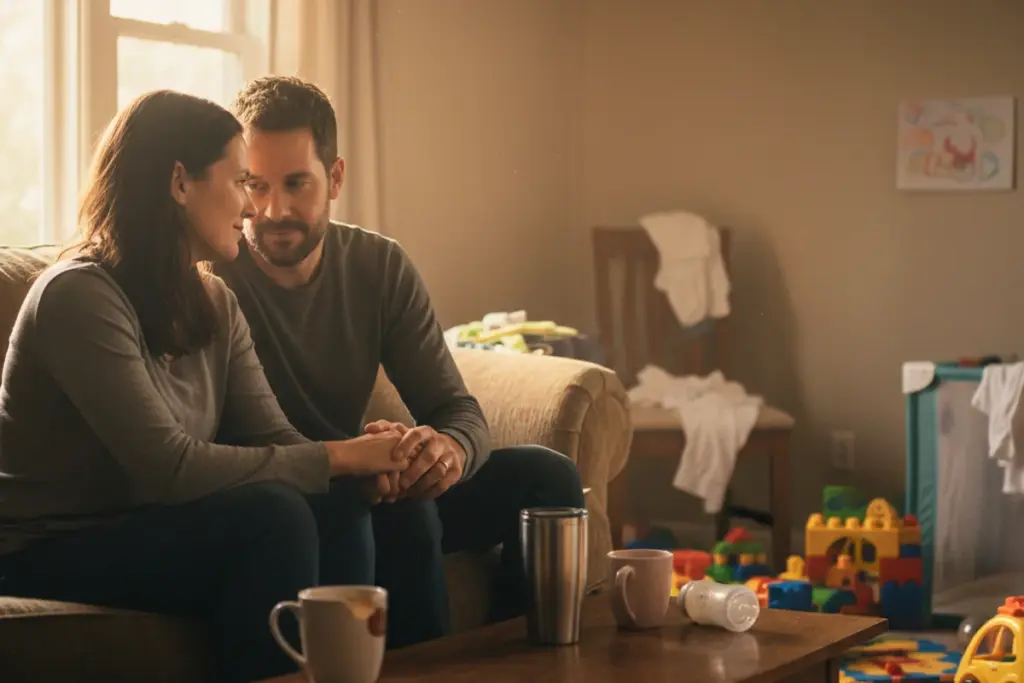



It was 9:47 PM when I realized we hadn’t actually talked in three days.
Sure, we’d exchanged hundreds of words. “Did you call the plumber?” “Can you pick up milk?” “The school needs the permission slip by Friday.” But a real conversation? The kind where you look into each other’s eyes and remember why you chose this person in the first place? That had vanished somewhere between diaper changes and carpool schedules.
I sat on the edge of our bed, watching my partner scroll through their phone, and felt a sudden, sharp loneliness. Not because they were ignoring me—we were sitting three feet apart—but because we had become experts at co-managing a household while completely missing each other as human beings.
This is the quiet crisis of modern parenting. We didn’t fall out of love. We fell out of conversation.
Quick Answer
Parents stop having real conversations due to chronic exhaustion, relentless logistical overload, and the slow drift into transactional communication. The path back requires intentional questions that bypass daily operations and reconnect with your partner you with who your partner actually is beneath the roles of “Mom” and “Dad.”
The Slow Fade Into Silence
Nobody plans for this. When we imagined parenthood, we pictured family dinners and bedtime stories. We didn’t anticipate that the sheer volume of daily decisions would eventually crowd out every other form of communication.
Research from the Gottman Institute confirms what many parents intuitively know: relationship satisfaction plummets in the first years of parenthood, not because of the children themselves, but because the couple’s emotional connection gets buried under an avalanche of practical demands.
The silence doesn’t arrive dramatically. It creeps in through a thousand tiny concessions. You stop asking “How was your day?” because you already know—their day was meetings and yours was tantrums. You stop sharing observations because there’s no time between soccer practice and dinner prep. You stop wondering about their inner world because you’re too busy managing the outer one.
Why Surface-Level Communication Takes Over
There’s a strange comfort in transactional conversations. They’re efficient. They keep the machine running. “Did you pay the electric bill?” has a clear answer. “Are you still happy with us?” does not.
Surface-level communication creates an illusion of connection. You’re talking constantly, so nothing seems wrong. But psychotherapist Esther Perel notes that many couples today have “intimacy without desire or desire without intimacy”—they maintain functional closeness while emotional distance quietly expands.
For parents, this dynamic is reinforced by the legitimate need to coordinate logistics. Someone has to remember the pediatrician appointment and the birthday party gift. But when every conversation becomes a task list, you eventually forget how to talk about anything else.
The Exhaustion Factor
Let’s be honest: deep conversation requires energy. It demands presence, curiosity, and emotional availability. After a day of negotiating with toddlers or navigating workplace politics, most parents have nothing left in the tank.
A 2023 study in the Journal of Marriage and Family found that parental burnout doesn’t just affect individual well-being—it fundamentally alters communication patterns within couples. Exhausted parents default to the path of least resistance: practical exchanges that require minimal cognitive or emotional investment.
The tragedy is that meaningful conversation is often exactly what exhausted parents need most. It’s the antidote to the isolation of caregiving, the reminder that you’re not just service providers for small humans but actual people with inner lives worth sharing.
The Identity Erosion
Perhaps the deepest reason conversations die is that parents often lose touch with who they are outside of their parental role. When someone asks “How are you?” and you can only answer in terms of your children’s achievements and challenges, something essential has been misplaced.
Your partner fell in love with a person, not a function. When you stop bringing your full self to the relationship—your dreams, your fears, your evolving perspectives—you become a stranger wearing a familiar face.
Five Questions That Reopen the Door
Rebuilding conversation requires intentional bridges back to each other. These five questions are designed to bypass the operational noise and touch what actually matters:
“What are you most looking forward to this month?”
This simple question shifts focus from past obligations to future possibility. It reveals what energizes your partner and creates space to dream together, even in small ways.
“What was the best part of your day that had nothing to do with the kids?”
This explicitly invites your partner to access parts of themselves outside parenting. It validates that their non-parent identity still matters and deserves airtime.
“Is there something you’ve been thinking about but haven’t said out loud?”
This creates permission for the unspoken. Often, parents withhold thoughts assuming there’s no time or that their partner isn’t interested. This question opens the door.
“When did you last feel really seen by me?”
Vulnerability invites vulnerability. This question acknowledges that you may have been absent and demonstrates genuine interest in repairing that gap.
“What would you want our kids to say about our relationship when they’re grown?”
This reconnects you to shared purpose and legacy. It shifts perspective from daily survival to the bigger picture you’re building together.
Making Space for Answers
Questions alone aren’t enough. You have to create the conditions where honest answers can emerge.
This means protecting time—actually scheduling it if necessary. It means putting phones in another room. It means listening without immediately problem-solving or redirecting to logistics. Sometimes it means accepting that one of you might cry, and that’s okay.
The goal isn’t to fix everything in one conversation. It’s to remember how to be in conversation at all.
Conclusion
Real conversations don’t die because parents stop caring. They die because caring gets buried under the weight of daily survival.
The path back starts with a single question asked with genuine curiosity. It continues with the courage to answer honestly. And it persists through the ongoing choice to see your partner not just as co-manager of your household, but as the person you still want to know.
Our best conversations aren’t behind us. They’re waiting for us to get quiet enough to hear them begin.