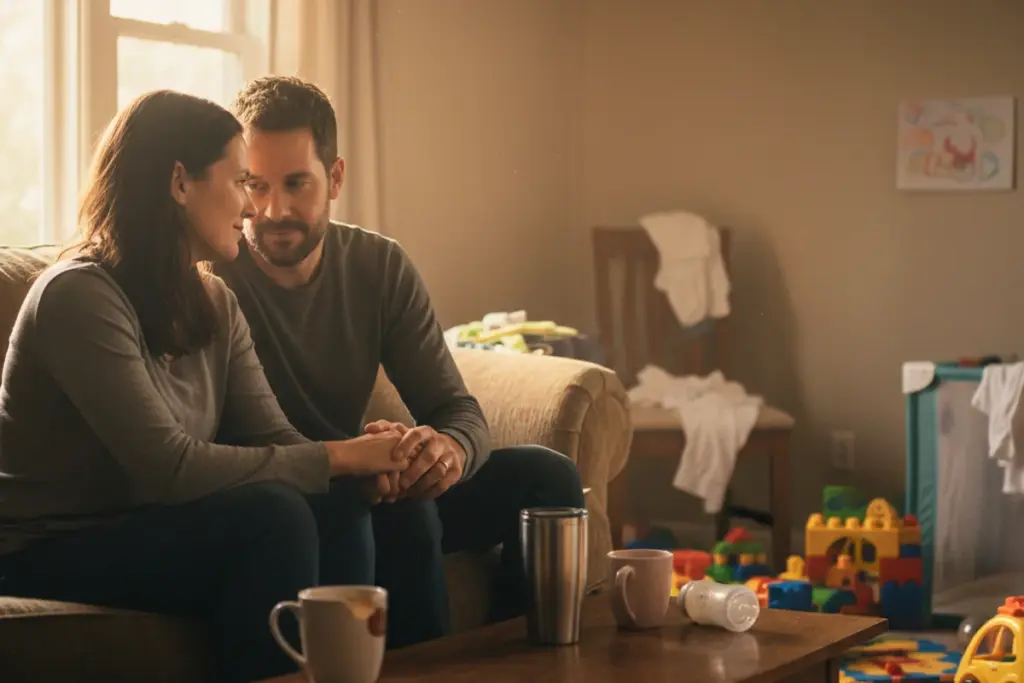



You pass each other in the hallway like ships at midnight. One of you is folding laundry while the other packs lunches for tomorrow. You coordinate schedules through calendar invites and text messages. You tag-team bath time and bedtime with military precision. On the surface, you’re a well-oiled machine—efficient, organized, perfectly functional.
But somewhere along the way, you stopped being spouses and started being roommates who share childcare duties.
If this feels painfully familiar, you’re not broken. You’re not failing at marriage. You’re experiencing one of the most common—and most fixable—challenges that parents face. The distance didn’t appear overnight, and it won’t disappear overnight either. But with intention and the right tools, you can find your way back to each other.
Quick Answer: When Marriage Feels Like Roommates
Marriages often drift into “roommate phase” because daily logistics consume all your energy, leaving nothing for emotional connection. Rebuild intimacy by scheduling 15-minute daily check-ins that go beyond kid-talk, asking open-ended questions from conversation decks like DeepDialogue, and making small physical connections (hand-holding, eye contact) throughout the day. Start with one meaningful conversation weekly.
How Did We Become Co-Parents Instead of Partners?
The transformation usually happens so gradually that you don’t notice until it’s complete.
It starts innocently enough. A newborn arrives, and survival becomes the only goal. Sleep deprivation makes deep conversations impossible. Your brain can handle logistics—who’s picking up from daycare, who’s buying diapers—or nothing at all. Emotional intimacy gets deferred to “when things calm down.”
But things don’t calm down. They just change. Toddlers bring new challenges. School schedules emerge. Activities multiply. The logistics expand to fill every available space in your relationship. Before you know it, you’re having detailed discussions about soccer practice logistics while forgetting to ask how your partner’s big presentation went.
The shift isn’t a character flaw. It’s a natural consequence of having more demands than energy. But natural doesn’t mean inevitable—or permanent.
Recognizing the Roommate Phase
Not sure if you’ve crossed the line from partners to co-parenting colleagues? Here are the telltale signs:
- Your conversations are 90% about the children, household tasks, or schedules
- You can’t remember the last time you discussed something that wasn’t practical
- Physical touch has become purely functional or disappeared entirely
- You feel more like a team at managing kids than a couple in love
- You experience a pang of loneliness even when sitting next to each other
- Date night feels awkward because you don’t know what to talk about anymore
If several of these resonate, you’re not in crisis. You’re in transition. And transitions, by definition, can move in new directions.
The Danger of the Functional Marriage
Here’s the tricky part: from the outside, your marriage might look fine. The kids are cared for. Bills are paid. There’s no obvious conflict. Friends might even comment on how well you “have it together.”
But functional isn’t the same as fulfilling. A relationship can operate perfectly as a household management system while starving the emotional connection that makes marriage meaningful.
The risk isn’t divorce tomorrow. It’s gradual numbness. Years of living parallel lives. Waking up one day realizing you’ve become excellent business partners but virtual strangers. The regret of realizing you could have reconnected, but you waited too long.
The good news? Recognition is the first step toward reversal.
Creating Space for Connection
The problem isn’t that you don’t love each other. The problem is that love requires space to breathe, and that space has been crowded out by the demands of daily life.
Reclaiming it starts with small, intentional acts:
Establish a No-Logistics Zone. Choose a time—after the kids are asleep, during a weekend coffee—when you’re not allowed to discuss schedules, tasks, or anything practical. This forces you to remember how to talk about ideas, feelings, dreams, and experiences.
Ask Different Questions. Instead of “How was your day?” try “What’s something you’re looking forward to this week?” Instead of “Did you call the plumber?” ask “When did you feel proud of yourself recently?” Questions that invite sharing rather than reporting.
Reintroduce Physical Connection. Not necessarily sex—though that’s part of it—but the small touches that communicate “I see you.” A hand on the shoulder. Eye contact that lasts three seconds longer than necessary. Sitting close enough to touch.
Questions That Bridge the Distance
When you’ve been in logistics mode for months, restarting meaningful conversation can feel awkward. Having thoughtful questions ready removes the pressure of figuring out what to say.
Questions from the DeepDialogue deck designed for exactly this situation:
- “What’s something you used to love doing that you haven’t had time for lately?”
- “If we had a whole day just for us, what would you want to do?”
- “What part of parenting do you think I’m really good at?”
- “What’s a dream you’ve put on hold that you still think about?”
- “When do you feel most understood by me?”
- “What’s something about our life right now that you’re grateful for?”
These questions do something powerful: they remind both of you that you’re still individuals with inner lives, not just roles.
When One Person Wants to Reconnect and the Other Doesn’t
Sometimes, you read articles like this and feel hopeful. You’re ready to make changes. But your partner seems content with the status quo—or too exhausted to try.
This is frustrating, but it’s not hopeless. Start by leading with your own vulnerability rather than criticism. Instead of “We never talk anymore,” try “I miss you. I miss the way we used to connect. Would you be willing to try one small thing with me?”
Make the barrier to entry as low as possible. Not “Let’s fix our marriage” but “Can we try talking for fifteen minutes tonight?” Small steps feel manageable even when big changes feel impossible.
The Long Road Back
Rebuilding intimacy isn’t a single conversation or one date night. It’s a gradual reweaving of the fabric of your relationship. Some days will feel easy. Others will feel forced. That’s normal.
The goal isn’t to return to your newlywed days. You’re different people now, shaped by experiences you couldn’t have imagined then. The goal is to build a new kind of closeness—one that includes the children and responsibilities you share, but isn’t defined by them.
Every question that goes deeper than logistics. Every moment of eye contact. Every honest sharing of your inner world. These are the bricks that rebuild the bridge between you.
Conclusion: Your Marriage Is Worth Fighting For
The roommate phase isn’t a death sentence for your marriage. It’s a warning light—an invitation to pay attention before the distance becomes permanent.
You chose each other for reasons that had nothing to do with parenting logistics. Those reasons still exist, buried under the to-do lists and exhaustion. They’re waiting to be rediscovered.
Tonight, put down the phones. Step away from the dishes. Look at your partner—not as your co-manager, but as the person you once couldn’t wait to talk to. Ask them one real question. Listen to their answer. Remember what it feels like to be genuinely interested in each other.
The path from roommates back to partners isn’t long. It just requires taking the first step.