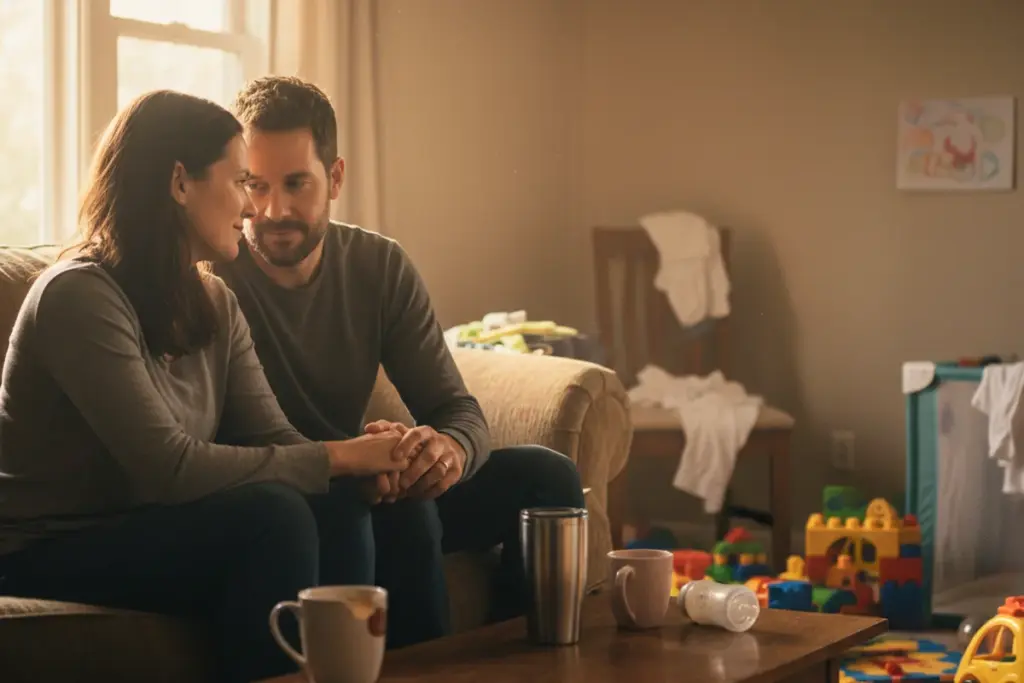



Postpartum depression affects roughly one in seven new mothers, and its ripple effects reach far beyond the person experiencing it. It reshapes the relationship between partners, creates distance where there used to be closeness, and can leave both people feeling like strangers in their own home. If you’re reading this, you might be in that space right now — wondering whether the connection you once had is still there, buried somewhere beneath the exhaustion and the silence.
It is. And it’s possible to find your way back to each other. But it requires honesty, patience, and a willingness to treat the recovery as something you do together rather than something one person goes through alone.
Understanding What Postpartum Depression Really Does to a Relationship
Postpartum depression doesn’t just make someone sad. It can manifest as irritability, emotional withdrawal, inability to bond with the baby, loss of interest in the relationship, or a combination of all of these. For the partner on the receiving end, this often feels like rejection — like the person they love has been replaced by someone distant and unpredictable.
The mistake many couples make is treating postpartum depression as a mood problem rather than what it actually is: a medical condition that affects the whole family system. When you reframe it that way, the question shifts from “Why won’t you snap out of it?” to “How do we treat this together?”
For the partner not experiencing PPD, the emotional toll is real and often overlooked. You may be carrying the household, managing the baby, absorbing emotional volatility, and mourning the relationship you had — all while being told you should just be supportive. That’s an enormous load, and it’s one that needs acknowledgment too.
How Do Couples Reconnect After Postpartum Depression?
Reconnection after PPD isn’t a single conversation or a magical weekend away. It’s a gradual process of rebuilding trust, emotional safety, and intimacy — and it starts with getting the clinical side right.
Step One: Treat the Depression First
Everything else depends on this. If the person experiencing PPD hasn’t sought professional help, that’s the starting point. Therapy, medication, or a combination can make an enormous difference. You cannot relationship-skill your way out of a clinical condition. As we discussed in the invisible mental load, untreated mental health challenges don’t just affect the individual — they cascade through the entire family.
Step Two: Name the Grief
Both partners need space to grieve what they’ve lost. The birth experience they imagined. The early bonding that was hijacked by depression. The relationship dynamic that used to feel effortless. Grief isn’t weakness — it’s the necessary acknowledgment that something was hard. And until you name it, it operates underground, showing up as resentment or emotional distance.
Rebuilding Emotional Safety
After PPD, trust is often fragile. The partner who was depressed may feel guilt about how they acted. The other partner may feel hesitant to be vulnerable again, fearing another withdrawal. Rebuilding emotional safety means creating a context where both people can be honest without fear of judgment.
Start small. A daily check-in where each person shares one thing that was hard and one thing that was good. These aren’t therapy-level disclosures — they’re micro-moments of vulnerability that rebuild the habit of turning toward each other rather than away.
Avoid the common trap of scorekeeping. “I was depressed for eight months, so now you owe me” or “I held everything together while you were struggling” — these are understandable feelings, but they’re relationship poison. If you need to process resentment, do it with a therapist, not as a weapon in a partner conversation.
What About Physical Intimacy?
This is one of the most fraught areas after PPD, and it deserves its own honest conversation. For the partner who experienced depression, physical intimacy may still feel overwhelming, unsafe, or disconnected from desire. For the other partner, the absence of physical closeness can feel like continued rejection.
The solution isn’t to push through discomfort or to ignore desire. It’s to decouple physical touch from sexual expectation. Hold hands. Cuddle on the couch. Give each other a back rub. Rebuild the body-to-body vocabulary slowly, without pressure. When both people feel safe enough to want more, intimacy will return — but trying to force it before safety is re-established will set you back.
For more on this topic, our article on regaining intimacy after kids explores the broader landscape of physical and emotional reconnection in relationships strained by parenthood.
When One Partner Is Still Struggling
Recovery from PPD isn’t linear. There will be good weeks and hard weeks, and one partner may feel ready to reconnect before the other does. That mismatch is normal, and it requires patience on both sides.
If you’re the partner who’s further along in recovery, resist the urge to pull the other person along. Your job is to stay present and available, not to set the pace. If you’re the one still struggling, communicate what you need — even if what you need is space. Silence breeds anxiety; words, even imperfect ones, build bridges.
And if you’re the non-depressed partner carrying an unfair share of the load, our piece on how to ask for help when you’re drowning offers concrete strategies for getting support before burnout becomes its own crisis.
The Connection You Build Back Is Stronger
There’s no sugarcoating it: postpartum depression changes a relationship. But couples who navigate it together often report that their relationship is stronger afterward — not in spite of what they went through, but because of it. They learned to communicate in ways they never had to before. They discovered resilience they didn’t know they had. They proved to each other that they would show up when things got hard.
Reconnecting doesn’t mean going back to who you were before. It means building something new on a foundation of honesty, shared struggle, and genuine care. That’s not a lesser version of love. If anything, it’s the real thing.