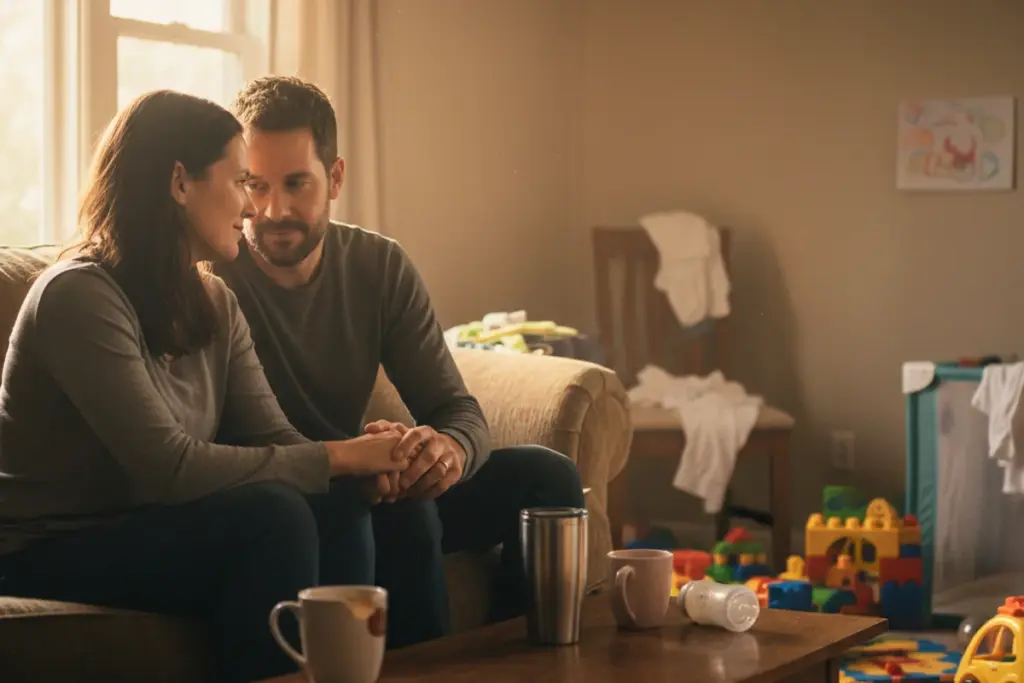



There is a particular kind of tension that emerges in the quiet moments after the baby arrives. It is the tension of realizing that the person you love most in the world grew up in a completely different universe than you did. Their normal was not your normal. Their family’s way of doing things feels foreign, maybe even wrong. And suddenly, every decision about how to raise this tiny human becomes a negotiation between two histories that never imagined each other.
This is the reality for most couples. You come from different families, different cultures, different value systems. You have different instincts about what children need, what love looks like, what discipline means, what success requires. And now you are supposed to agree on everything while sleep-deprived and overwhelmed.
Quick Answer
Aligning parenting philosophies requires three steps: understand your own upbringing and triggers, listen to your partner’s perspective without judgment, and create intentional agreements about your shared values. DeepDialogue provides structured questions to facilitate these conversations before conflicts arise.
Why Your Upbringing Matters More Than You Think
Our parenting instincts are not random. They are shaped by what we experienced as children, for better or worse. The way your parents showed love becomes your default setting for showing love. The way they handled conflict becomes your template for handling conflict. The values they prioritized become the values you assume are universal.
This is not about blame. Your parents did their best with what they knew. But their best created a specific worldview that you now bring into your own parenting partnership. And your partner brings a different worldview. The collision of these worldviews is inevitable. The question is whether you navigate it with intention or let it navigate you.
The Danger of Unexamined Assumptions
Most couples never have explicit conversations about parenting philosophy before becoming parents. They assume they agree because they agree on other things. They assume shared values will translate to shared parenting. They assume love will be enough.
Then the baby arrives, and suddenly everything is up for debate. Should the baby sleep in your room or their own? Should you let them cry or pick them up immediately? Should you return to work or stay home? Should you prioritize academic achievement or emotional intelligence? Should you be strict or permissive?
Without prior conversation, each question becomes a battle of unexamined assumptions. You are not fighting about the baby. You are fighting about whose childhood gets to be the template for this new family. And that is a fight nobody can win.
Understanding Your Own Story
The first step toward alignment is understanding your own story. What was your childhood like? What did your parents do well? What do you wish they had done differently? What patterns do you see yourself repeating? What triggers you?
These questions are not about judgment. They are about awareness. You cannot change what you do not acknowledge. You cannot choose differently if you do not know what you are choosing.
DeepDialogue cards help with this reflection. They ask questions like: What did love look like in your family growing up? How did your parents handle conflict? What values were most important in your household? What would you repeat with your own children? What would you change?
Understanding Your Partner’s Story
Once you understand your own story, you need to understand your partner’s. This requires genuine curiosity without defensiveness. Their different upbringing is not a rejection of yours. It is simply a different experience that shaped them differently.
Ask them the same questions you asked yourself. Listen without interrupting. Resist the urge to defend your own upbringing or criticize theirs. Just hear their story. What was hard for them? What was good? What do they want to recreate? What do they want to leave behind?
This is where empathy becomes possible. When you understand that your partner’s insistence on structure comes from childhood chaos, you can respond with compassion instead of irritation. When you understand that their casual approach comes from a relaxed upbringing, you can negotiate instead of judge.
Finding the Overlap
After you understand both stories, look for overlap. What values do you share? What outcomes do you both want for your children? What kind of adults do you hope they become?
The overlap is your foundation. It is the common ground where you can build something new together. Maybe you both prioritize kindness over achievement. Maybe you both want your children to feel unconditionally loved. Maybe you both value independence. Whatever the overlap is, start there.
Then identify the differences. Where do you disagree? Are these differences fundamental or tactical? Can you compromise, or do you need to choose one approach? Be honest about what is negotiable and what is not.
Creating Intentional Agreements
Alignment does not mean agreement on everything. It means having explicit conversations about your differences and creating intentional agreements about how you will handle them.
Maybe you agree to try your partner’s way for three months, then reassess. Maybe you agree to handle different domains according to different philosophies. Maybe you agree to get outside help for areas where you cannot find middle ground.
The key is intentionality. You are not drifting into conflict. You are choosing your path with awareness. You are building a parenting philosophy that honors both of your histories while creating something new.
The Questions That Help
Here are questions worth asking before you become parents: How do we each define good parenting? What values are non-negotiable for each of us? What are we willing to compromise on? How will we handle it when we disagree? What happens if one approach is not working?
These conversations are not one-time events. They are ongoing dialogues that evolve as you learn more about yourselves and your children. The goal is not perfect alignment. The goal is mutual understanding and intentional choice.
Conclusion
Aligning your parenting philosophies is not about finding perfect agreement. It is about understanding each other’s stories, finding your shared values, and creating intentional agreements about your differences. It is about building a parenting approach that honors both of your histories while creating space for something new.
DeepDialogue exists to facilitate these conversations. The cards provide prompts that help you explore your upbringings, understand each other’s perspectives, and create alignment before conflicts arise. Start today. Ask one question. Build your foundation one conversation at a time.