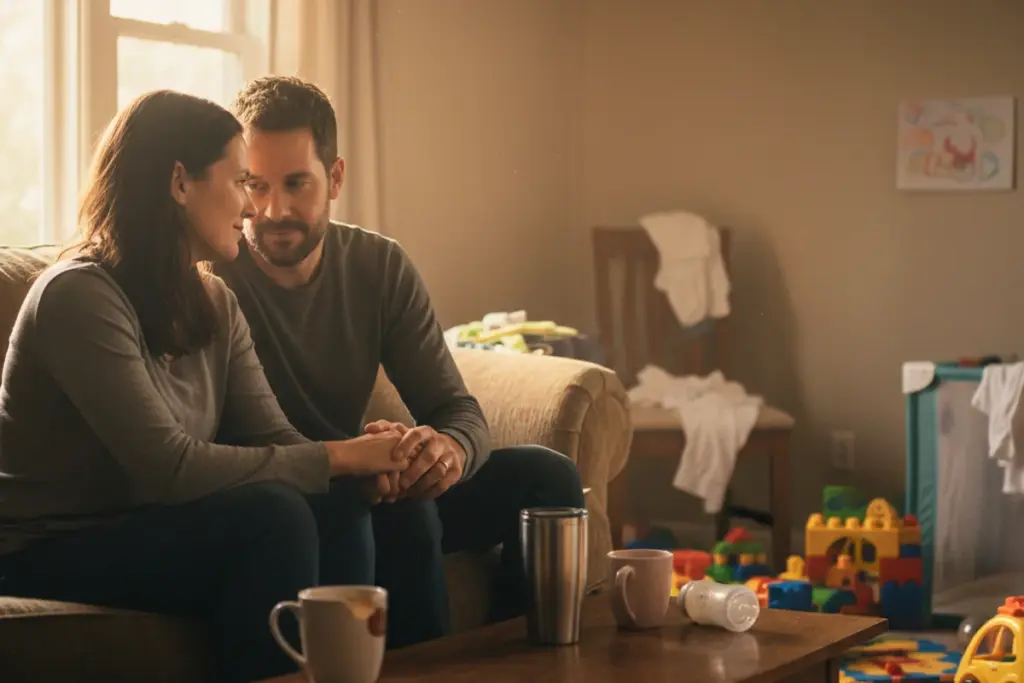



Everyone tells you the first year with a baby is the hardest. So when you’re expecting your second, you figure you’ve got this. You’ve done it before. You know the swaddles, the sleep schedules, the feeding routines. What could go wrong?
A lot, as it turns out. Because adding a second child isn’t doing the same thing twice. It’s doing everything at once, with fewer hands and a toddler who still needs you just as much as before.
The transition from zero to one child is a shock. But the transition from one to two is a different kind of shock — one that many parents are completely unprepared for, precisely because they assume their first-child experience has them covered.
Why No One Warns You About the Second Baby
There’s a cultural narrative that says having your first baby is the big adjustment, and everything after that is incremental. Friends and family focus on the firstborn’s milestones. The second baby, by contrast, often arrives with less fanfare, less help, and less of a village.
Parents report feeling blindsided by how much harder things feel the second time around. The sleep deprivation is the same. The feeding challenges are similar. But now there’s also a three-year-old who wants to be held while you’re nursing. A morning routine that used to take 30 minutes now takes 90. And the mental load doubles without the support doubling.
Research on second-child families consistently shows that parental stress and relationship satisfaction tend to dip more sharply after the second child than after the first. It’s not because the second baby is inherently more difficult. It’s because the system — you, your partner, your household — was already running at capacity.
The Math Doesn’t Work in Your Favor
With one child, you and your partner can sometimes tag-team. One rests while the other takes a shift. With two, the equation shifts. A toddler and a newborn rarely nap at the same time. Someone always needs something. And the concept of “off duty” essentially disappears.
Even simple tasks become logistics puzzles. Grocery runs require a stroller strategy. Bath time is a two-person operation. Date night? You now need childcare for two age groups, which means either two sitters or one very capable one who costs significantly more.
If you’ve been carrying the default parent role, the arrival of a second child doesn’t redistribute that weight. It multiplies it. And unless you and your partner have intentionally restructured how you share responsibilities, the default parent just became the default parent times two.
Sibling Dynamics Add a New Stressor
Your toddler didn’t ask for a sibling. From their perspective, the new baby is a tiny intruder who has stolen their parents’ attention, their lap space, and their place as the center of the universe.
This shows up as regression — suddenly your potty-trained three-year-old wants diapers again. Or aggression — hitting, biting, throwing things near the baby. Or clinginess that makes it impossible to put the baby down because the toddler is wrapped around your leg.
These behaviors are completely normal. But they’re also exhausting to manage, especially when you’re already running on empty. And they create a terrible dynamic where you’re constantly mediating between a newborn who needs everything and a preschooler who feels like they’ve lost everything.
Your Relationship Takes a Bigger Hit
The first baby puts stress on a marriage. The second baby puts even more stress on an already-stressed marriage. The margin for error is thinner. The patience is shorter. The opportunities for connection — a quick conversation, a shared joke, even just eye contact across the room — become vanishingly rare.
If you and your partner haven’t built strong communication habits before the second baby arrives, the cracks widen fast. That first fight after baby you thought was behind you? It comes back, bigger and louder, because now the stakes are higher and the reserves are lower.
Many couples describe the second-child period as the loneliest chapter of their relationship. Not because they love each other less, but because they’re both so depleted that there’s nothing left to give. The love is there. The energy to express it isn’t.
Practical Strategies for Surviving the Transition
You can’t eliminate the chaos of adding a second child. But you can prepare for it in ways that reduce the damage:
**Lower every expectation.** For the first three to six months, your house will be messier, your meals simpler, and your social life quieter. This is temporary. Plan for it so it doesn’t feel like failure.
**Divide and communicate.** Before the baby arrives, have explicit conversations about who handles what. Not “we’ll figure it out.” Write it down. Who does morning routine? Who handles toddler bedtime? Who gets up with the baby on Tuesdays? Asking for help starts before you need it.
**Protect micro-moments of connection.** A five-minute conversation while one of you showers. A text that says “I see you working hard.” These tiny moments are the lifelines that keep you from drifting into parallel isolation.
**Accept outside help.** If family offers to watch the toddler, say yes. If a friend drops off a meal, accept it graciously. The myth that you should handle two kids the same way you handled one is just that — a myth.
**Watch for the resentment trap.** If you find yourself thinking “I’m doing everything” on repeat, that’s resentment forming. Name it early. Talk about it directly. Don’t let it calcify.
The Season That No One Prepares You For
The second-child transition is a season of squeezing — of being stretched beyond what you thought you could handle. It’s also temporary. Most families find a new rhythm within six to twelve months. The baby starts sleeping more. The toddler adjusts. You and your partner find your footing again.
But “temporary” doesn’t mean “easy.” And pretending it’s easy makes it harder. The couples who navigate this transition best are the ones who acknowledge how hard it is, ask for what they need, and give each other grace during the messy middle.
Fazit
The second baby trap isn’t that having two children is objectively harder in every way. It’s that the difficulty catches you off guard because you expected your prior experience to be enough. It’s that the systems and routines that worked for one child don’t scale. It’s that you and your partner were already at capacity and now the demands have doubled.
Knowing this ahead of time doesn’t make the transition painless. But it does make it less isolating. It gives you language for what you’re feeling and permission to say it out loud: this is harder than I expected, and that’s normal.
You’ve done this before — but not like this. And that difference matters more than anyone told you it would.